The liquid packaging industry is currently experiencing a period of significant technological advancement, driven by the increasing global demand for beverages, pharmaceuticals, and household chemicals. In this competitive landscape, the efficiency of your production line is almost entirely dependent on selecting the correct filling machine. Whether you are a startup craft brewery or a large-scale mineral water distributor, the decision-making process involves a complex analysis of liquid viscosity, container material, and desired throughput. A poorly chosen filling machine can lead to significant product waste, downtime, and high maintenance costs, whereas a well-integrated system can maximize ROI and ensure product quality.
When choosing the best bottle filling machine, you must prioritize the viscosity of your product, the material and shape of your containers (such as glass or PET), the required production speed (BPM), and the specific hygienic standards of your industry, while ensuring the dosing system—whether volumetric, gravity, or isobaric—is compatible with your liquid’s chemical properties.
Understanding these variables is crucial for B2B procurement managers and plant engineers who need to optimize their supply chains. A specialized Water Filling Machine will have vastly different technical requirements than a Beer Filling Machine, primarily due to carbonation levels and oxygen sensitivity. Similarly, a Glass Bottle Filling Machine requires more sophisticated handling components to prevent breakage compared to a line for plastic bottles. In the following sections, we will break down the essential characteristics of these machines, explore the various dosing technologies available, and provide a framework for selecting a system that balances automation with operational flexibility.
Table of Contents
Filling bottles with liquid – characteristics of liquid filling machines
Types of filling machines
Filling bottles – types of dosing systems
Automated bottle filling system. Summary
Filling bottles with liquid – characteristics of liquid filling machines
The primary characteristics of a liquid filling machine include its ability to handle specific liquid viscosities, its sanitary design (CIP/SIP compatibility), accuracy in dosing to minimize product giveaway, and its adaptability to different bottle shapes and sizes through quick changeover features.
At its core, a filling machine is defined by its precision. In the B2B sector, "product giveaway" is a major concern. If a filling machine overfills by just 1%, a high-speed line can lose thousands of dollars in product every week. Therefore, high-quality machines are characterized by advanced flow meter technologies or piston systems that guarantee a deviation of less than 0.5%. Furthermore, the construction materials must be considered. Most professional machines utilize 316L stainless steel for all fluid-contact parts to meet FDA and CE standards, ensuring that the Water Filling Machine or beverage filler remains free from bacterial growth and corrosion.
Adaptability is another hallmark of a modern filling machine. A versatile line should be able to switch between different bottle heights and neck diameters with minimal downtime. This is achieved through the use of modular star wheels and adjustable guide rails. For a Glass Bottle Filling Machine, specific characteristics like "soft-start" and "soft-stop" mechanisms are integrated into the conveyor system to ensure that fragile glass containers do not collide and shatter during the high-speed filling cycle. These features are essential for maintaining a high Overall Equipment Effectiveness (OEE).
Finally, the environmental control within the filling machine is a critical characteristic for sensitive products. For example, a Beer Filling Machine must characterize its operation with "pre-evacuation" to remove oxygen from the bottle, as oxygen is the primary enemy of beer shelf life. Meanwhile, a Water Filling Machine might focus more on high-speed ozone-rinsing characteristics to ensure the water remains pure. These industry-specific characteristics ensure that the machine does not just fill a bottle, but preserves the integrity of the product inside.
Types of filling machines
The market offers several distinct types of filling machines, categorized primarily by their movement (linear vs. rotary) and their level of automation (manual, semi-automatic, or fully automatic), each suited to different scales of production.
When evaluating a filling machine, the first distinction is often between linear and rotary configurations. Linear machines are generally more affordable and easier to set up, making them ideal for small to medium-sized enterprises (SMEs). They fill bottles in a straight line, usually in batches of 2, 4, 6, or 8. However, for high-capacity industrial needs, a rotary filling machine is the standard. In a rotary system, bottles move continuously in a circle, and filling occurs as they rotate. This allows for much higher speeds, which is why a high-output Water Filling Machine or Beer Filling Machine is almost always a rotary system, capable of reaching speeds of 10,000 to 40,000 bottles per hour.
Another categorization is based on the container material. A Glass Bottle Filling Machine is specifically built to handle the weight and rigidity of glass. These machines often include specialized rinsing modules and capping heads designed for crown corks or aluminum ROPP caps. On the other hand, PET-focused machines are designed to be lightweight and may use "neck-handling" technology, where the bottle is suspended by its neck ring throughout the process. This prevents the thin walls of plastic bottles from being crushed during the filling or capping phase.
Furthermore, the level of automation is a deciding factor for B2B buyers. Manual and semi-automatic machines are suitable for lab use or small boutique productions, where an operator manually places the bottle under the nozzle. Fully automatic systems, however, integrate seamlessly into a complete line. A fully automatic filling machine will include "no-bottle, no-fill" sensors, automatic PLC controls, and synchronized communication with upstream blow molders and downstream labeling machines.
Comparison Table: Linear vs. Rotary Filling Machines
| Feature | Linear Filling Machine | Rotary Filling Machine |
| Production Speed | Low to Medium (up to 60 BPM) | High to Ultra-High (up to 600+ BPM) |
| Footprint | Rectangular/Long | Circular/Compact |
| Changeover Time | Faster/Easier | More complex/requires star wheels |
| Ideal For | Craft producers/diverse bottle types | Large-scale mass production |
| Typical Application | Craft Beer Filling Machine | Mass-market Water Filling Machine |
Filling bottles – types of dosing systems
Dosing systems are the technical mechanisms that measure the liquid, including gravity fillers for thin liquids, overflow fillers for aesthetic consistency, piston fillers for thick pastes, and isobaric systems for carbonated beverages.
The dosing system is the most technical part of a filling machine. For thin, free-flowing liquids like spring water, gravity fillers are often the most efficient. These systems use a simple timed-valve or a float-level sensor to fill the container. Because water does not foam or stick, a Water Filling Machine can utilize these cost-effective dosing systems to achieve massive throughput. However, gravity filling is unsuitable for viscous liquids like oils or detergents, which require a piston-driven dosing system to "push" the liquid accurately into the container.
In the world of retail beverages, the overflow dosing system is highly popular, especially for a Glass Bottle Filling Machine. Overflow fillers ensure that every bottle on the store shelf looks like it has been filled to exactly the same height, regardless of minor variations in the glass bottle's internal volume. The nozzle creates a seal and pumps liquid in until it reaches the overflow port, at which point excess liquid is returned to the main tank. This is perfect for juices, spirits, and clear liquids where visual uniformity is a key selling point for the brand.
For carbonated drinks, the isobaric (counter-pressure) dosing system is mandatory. This is the core technology of a Beer Filling Machine. The system first pressurizes the bottle with CO2 to match the pressure in the filling tank. Once the pressures are equal, the liquid flows in under gravity without foaming. If you tried to fill a carbonated beverage with a standard filling machine, the liquid would erupt into foam, resulting in inconsistent fill levels and flat beer. Modern isobaric systems also include a "snifting" phase to slowly release the pressure after the fill, ensuring no product is lost when the nozzle is removed.
Automated bottle filling system. Summary
An automated bottle filling system is a comprehensive integration of rinsing, filling, and capping modules that utilizes PLC technology to maximize efficiency, reduce labor costs, and ensure consistent product quality across large-scale production runs.
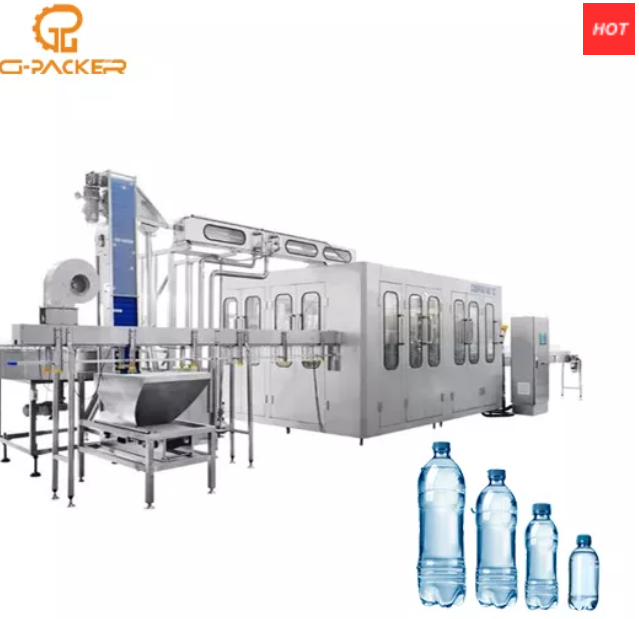
In summary, the transition to an automated filling machine represents a significant upgrade in production capabilities. Most high-end B2B solutions are now "Monoblock" systems, which combine three essential functions—washing, filling, and capping—into a single machine frame. This integration minimizes the distance the bottle must travel, reducing the risk of contamination and breakage. For a Water Filling Machine, this might involve a 3-in-1 system that handles PET bottles from the moment they are blown until they are ready for the labeler. For a Beer Filling Machine, it ensures that the time between filling and capping is minimized, which is vital for preserving freshness.
The ROI of an automated filling machine is driven by several factors:
Reduction in Labor: One operator can often manage an entire automated line.
Consistency: Every bottle is filled and capped to the exact same specification.
Scalability: Automated systems can run 24/7 to meet seasonal demand spikes.
Waste Mitigation: Precise dosing systems significantly reduce the loss of expensive raw materials.
Ultimately, the best filling machine is one that aligns with your specific product roadmap. If you are scaling a premium soda brand, a Glass Bottle Filling Machine with isobaric dosing is your path to success. If you are distributing bulk distilled water, a high-speed linear or rotary Water Filling Machine will be your workhorse. By carefully considering the liquid's characteristics, the container's material, and the required dosing precision, businesses can invest in a solution that provides long-term stability and growth.
Conclusion
Choosing the right filling machine is a multi-faceted process that requires a deep understanding of your product, your packaging, and your production goals. Whether you are looking for a Glass Bottle Filling Machine to maintain a premium brand image or a high-speed Water Filling Machine to dominate the commodity market, the technology you select today will define your operational efficiency for years to come. By focusing on the dosing system, the machine type, and the level of automation, you can ensure a smooth, hygienic, and profitable production cycle.


